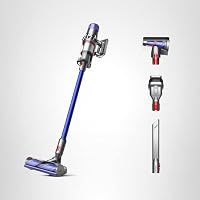
Dyson V8 vs V15: Which Should You Buy? (November 2026)
The V15 Detect is the better buy for most homes because it doubles the V8's power and adapts suction to the floor. Pick the V8 Cyclone if weight and simplicity matter more than smart cleaning.
On this page (9 sections)
The V15 Detect is the better buy for most homes because it doubles the V8's power and adapts suction to the floor. Pick the V8 Cyclone if weight and simplicity matter more than smart cleaning.
This Dyson V8 vs V15 comparison looks at the two cordless vacuums buyers weigh most often. The V15 is the newer, more powerful machine.
The V8 Cyclone is the latest version of Dyson's long-running light frame. The V8 Animal is also in the mix for pet homes that want the older V8 body with a direct drive head.


Dyson V8 vs V15: the quick verdict
Buy the V15 Detect for whole-home deep cleaning and the V8 Cyclone for light, everyday pickups. The V15's extra power and two cleaner heads justify the step up for most people.
Dyson rates the V15 at 100% more power than the V8, which is the biggest single difference between them. The V8 Cyclone answers with a lighter frame and a simpler control layout.
The V15 also reads the floor. A sensor detects debris and adjusts suction, and the LCD screen shows the particle count as you clean.
The V8 leaves power choice to you through its three modes.
If you want one vacuum for carpets, hard floors and pet hair, the V15 covers more ground. If you want something easy to grab for crumbs and stairs, the V8 Cyclone is the friendlier tool.
The third option, the V8 Animal, sits between them: the same 0.14-gallon bin and light V8 build, but tuned for pet homes with a direct drive head and a washable filter.
The two side by side
The V15 wins on power and intelligence, while the V8 Cyclone wins on weight and simplicity. The table below lines up the specs that separate them.
| Feature | Dyson V15 Detect | Dyson V8 Cyclone |
|---|---|---|
| Power | 100% more than the V8 | 30% more than the original V8 |
| Run time | 60 minutes | 60 minutes in Eco mode |
| Weight | 6.8 lb | 5.7 lb |
| Bin capacity | 0.2 gallons | 0.14 gallons |
| Cleaner heads | Fluffy Optic and Digital Motorbar | Motorbar and All Floor Cones |
| Controls | Power trigger with auto mode | Power button with three modes |
| Screen | LCD with particle count | None |
| Dimensions | 10.4"L x 9.8"W x 49.6"H | 8.3"L x 9.8"W x 45.7"H |
| Best for | Whole-home deep cleaning | Lighter everyday cleaning |
| Product | Best for | Run time | Weight | Bin capacity | Our score |
|---|---|---|---|---|---|
| Dyson V15 Detect Cordless Vacuum | whole-home deep cleaning | 60 minutes | 6.8 lb | 0.2 gallons | 9.0 |
| Dyson V8 Cyclone Cordless Vacuum | lighter everyday cleaning | 60 minutes | 5.7 lb | 0.14 gallons | 9.7 |
| Dyson V8 Animal Cordless Stick Vacuum Cleaner | pet hair on a budget | 40 minutes | 5.64 lb | 0.14 gallons | 9.6 |
| Lemige V11 V15 Vacuum Filter Dust Bin | V15 upkeep | 9.3 |
The bin gap matters more than it looks. A 0.2-gallon bin means fewer trips to the trash on a full-house clean.
The V8's 0.14-gallon bin fills faster, which is fine for a quick pass but not for a whole floor.
Weight is the trade in the other direction. The 1.1-pound difference is small on paper.
Held overhead to dust a ceiling fan or carried up a flight of stairs, you'll notice it.
The height figures tell a related story. The V15 stands 49.6 inches tall and the V8 Cyclone 45.7 inches, so the V8 sits lower and is easier to stow in a closet or behind a door.
The V15's taller frame comes from the longer wand and bigger bin. If storage space is tight, the shorter machine is the one that slips into a corner without a fight.
Which one cleans better on carpets and hard floors?
The V15 cleans deeper on carpets and adapts to floor changes; the V8 Cyclone still handles both surfaces well. Carpet depth and mixed flooring favor the V15.
The V15 ships with two heads. The Digital Motorbar head is built for all floor types and de-tangles long hair and pet hair as you clean.
The Fluffy Optic head is for hard floors, and its light reveals fine dust you can't see. Dyson compares the light head to the original Laser Slim Fluffy head, so the visibility gain is the selling point rather than extra suction.
The V8 Cyclone pairs a Motorbar head with All Floor Cones. Dyson says the cones de-tangle all hair lengths and reveal invisible dust, and the head is designed for all floor types.
So the V8 isn't a hard-floor-only or carpet-only vacuum. Its de-tangling works on the same wrapped hair problem the V15's Motorbar head handles.
The difference is how much the vacuum does for you. The V15 adjusts suction based on what it detects.
On the V8 you pick the mode yourself, which means more thinking and less automation. The V15's Digital Motorbar head also adapts suction power to floor type, so moving from a rug to bare boards doesn't need a mode change.
What the V15's screen adds
The LCD screen shows the total particles picked up as you clean, plus the power mode and remaining run time to the second. Maintenance alerts also appear there.
Dyson notes the particle count is most accurate in Auto mode, where the auto ramp feature also runs.
That's feedback, not cleaning. It helps you see when a carpet needs another pass, and the to-the-second run time takes the guesswork out of when to stop.
If you'd rather not watch a screen while you vacuum, it adds little. The same goes for the particle count on a floor you already know is clean.
The screen earns its keep most in homes with pets and high-traffic rooms.
How much does weight matter day to day?
The V8 Cyclone is the easier vacuum to carry and lift, at 5.7 pounds against 6.8 for the V15. For stairs and overhead cleaning, that gap is the V8's main advantage.
A cordless vacuum gets lifted more than a corded one. You carry it between rooms, up stairs, and above your head to reach cobwebs and ceiling corners.
Both convert to a handheld with one click. The V8 Animal, at 5.64 pounds, is a hair lighter still than the V8 Cyclone.
The V8's lighter frame makes those moments less tiring. Its power button also means you don't hold a trigger for the whole clean, which helps on longer sessions.
On the V15 the trigger only uses battery while you press it, which stretches run time but asks your finger to work for the whole clean. Pick by which annoyance bothers you more.
The V15's 1.1-pound penalty buys double the power, two heads and a bigger bin. That's a fair trade for a whole-house clean.
It's a poor trade if the vacuum lives on a hook in a small flat and comes out for ten-minute bursts.
Run time in real rooms
Both are rated up to 60 minutes. Dyson's 60-minute figure for the V8 Cyclone applies in Eco mode in handheld configuration.
The V15 figure varies by power mode, dust level and floor type. The V8 Animal is rated up to 40 minutes with a non-motorized tool and up to 25 minutes with the motorized floor tool attached.
Treat 60 minutes as the best case on both. Higher power and motorized heads shorten it.
The V15's auto mode spends power where debris is detected, so it manages the battery for you. The V8 Cyclone leaves that budgeting to you, and its three modes are the tool for the job.
On a big carpet the Boost end of the dial drains a charge quickly on either vacuum.
Bin size and emptying
The V15's 0.2-gallon bin holds about 40% more than the V8 Cyclone's 0.14-gallon bin. Larger homes and shedding pets will empty the V8 more often.
The V8 Animal carries the same 0.14-gallon bin as the Cyclone.
Both empty with a hygienic dirt ejector, so you don't touch the debris. That's the same convenience on either vacuum.
The V15's bin release is built to seal tightly, and the V8's empties with a single action.
The difference is frequency. On a whole-house clean, the V15's larger bin means fewer stops.
With a heavy-shedding dog, the V8's bin fills quickly enough that you'll notice. A bigger bin also means more weight up front.
The V15 carries that extra capacity in a heavier body. If you clean one room at a time, the V8's smaller bin rarely gets in the way.
Keeping spares on hand
Every cordless vacuum slows down when its filter is dirty. The fix is a wash and a full dry, which means waiting before the next clean.
A spare filter set removes the wait. The Lemige kit below pairs a dust bin with an H13 filter, and both fit V11 and V15 models only.
V8 owners need V8-specific parts, so don't buy this kit for a Cyclone or an Animal.
Filtration and air quality
Both vacuums use advanced whole-machine filtration rated to trap 99.99% of particles as small as 0.3 microns. Allergy-minded buyers get the same headline claim from either.
Dyson says the V15's filtration is tested in Boost mode, and its other modes reach at least 99.97%. The V8 Cyclone's figure comes from a 2025 lab test in Boost mode.
In plain terms, both expel cleaner air than they take in. The V8 Animal makes the same claim in different words and adds a washable lifetime filter.
Filtration depends on maintenance. A clogged filter cuts suction and lets more dust back into the room.
That's true on every model here. The Lemige filter kit earns its place for V15 owners as a spare, and the V8 Animal's washable filter keeps its upkeep simple.
V8 owners need V8-specific parts. Our Dyson V8 review covers what the older model needs to stay in shape.
Who should buy the V15 Detect?
Buy the V15 Detect if you have a mix of carpets and hard floors and want the vacuum to adjust for you. It's the stronger whole-home machine.
The V15 suits larger homes where one vacuum has to handle several floor types. The Fluffy Optic head's light helps on hard floors, and the auto mode takes the guesswork out of power settings.
The taller 49.6-inch frame and 0.2-gallon bin suit a full pass through the house without a mid-clean empty.
Pet homes benefit too. The Digital Motorbar head de-tangles long hair and pet hair as you clean, and the particle count shows when a carpet needs another pass.
The bigger bin means fewer emptyings on a full-house session.
Skip it if the extra weight would stop you from cleaning as often. A vacuum you avoid using is worse than a lighter one you reach for.
The same goes if you already know your floors are clean and would never look at the particle count.
Who should buy the V8 Cyclone?
Buy the V8 Cyclone if you want a light, simple vacuum for quick daily cleaning. It's the easier machine to carry and control.
The V8 Cyclone fits apartments, stairs and homes where cleaning happens in short bursts. At 5.7 pounds, it's light enough to grab for a spill and put away without a second thought.
The power button means no trigger to hold. Its shorter 45.7-inch frame fits tighter storage spots than the V15.
Its Motorbar and All Floor Cones heads handle carpets and hard floors, so it isn't limited to one surface. Three modes let you dial power up when you need it.
Dyson also rates it at 30% more power than the original V8, so it isn't a step back from the V8 line it replaces.
Skip it if you have a big home and hate stopping to empty the bin. The smaller bin will interrupt long cleans.
If you're weighing the older V8 against its successor, our V8 vs V10 comparison shows what changed between generations. Pet owners with deep carpet may also want to look at the V8 Animal and its direct drive head.
Which Dyson cordless vacuum fits your home?
Pick the V15 for power and automation, or the V8 Cyclone for lightness and simple controls. The Dyson V8 vs V15 choice comes down to how much cleaning your home demands.
Go with the V15 Detect if you clean several rooms in one go, have pets that shed, or want the vacuum to adjust power for you. The double power and two heads make it the stronger deep-clean tool, and the 0.2-gallon bin cuts the number of stops.
Go with the V8 Cyclone if you want a vacuum you can lift easily and use without thinking. The lighter frame, shorter body and power button make short work of everyday messes.
It also comes with the All Floor Cones head and three modes, so simple doesn't mean limited.
If neither feels like the right fit, our guide to which Dyson cordless vacuum you should buy walks through the full lineup. For a closer look at the next step up from the V8, read our Dyson V10 vs V11 comparison.
Frequently asked questions
Is the Dyson V15 better than the V8?
Yes for raw cleaning power. Dyson says the V15 has 100% more power than the V8, and it adds auto suction adjustment and two cleaner heads.
The V8 Cyclone is lighter and simpler, so it wins for stairs and quick tidy-ups.
How long do the V8 and V15 run on a charge?
Both are rated at up to 60 minutes. The V15 figure applies across its modes with auto adjustment, while the V8 Cyclone reaches 60 minutes in Eco mode.
Heavier modes cut run time on either vacuum.
Which Dyson is lighter, the V8 or V15?
The V8 Cyclone weighs 5.7 pounds and the V15 Detect weighs 6.8 pounds. That 1.1-pound gap shows up most when you clean overhead or carry the vacuum up stairs.
Do V8 and V15 parts fit each other?
No. The V8 and V15 use different bins and filters.
The Lemige bin and filter kit fits V11 and V15 models only, so V8 owners need V8-specific parts.
Is the V15 worth it for hard floors?
Yes if you want to see dust you would otherwise miss. Its Fluffy Optic head lights up fine dust on hard floors, and the screen counts particles as you clean.
The V8 handles hard floors well without those extras.